This is something I am on at the moment. A ketogenic diet is a “fat burning” diet. The Atkins Diet happens to be a ketogenic diet, but I am not following any direct Atkins guidelines.
Ketosis
One primary result of a ketogenic diet is an effect called ketosis, where the bloodstream has elevated levels of ketone bodies. Ketone bodies are formed from stored fatty acids after you have depleted your ready supply of glucose and your liver has also exhausted its glycogen stores.
Glycogen
Glycogen is the stored form of excess glucose. When you eat a meal rich in carbohydrates, your body converts the carbs into pure glucose and some other things. If you consume excess glucose, more than your body needs immediately, it is converted and stored away as future potential energy in the form of fatty acids and glycogen. This is why it is understood that a high-carb diet can actually make you fatter, even if you are restricting overall calories.
Fuel Priorities
As you go about your daily business, or sleep at night, your body must have energy to keep running, so it first turns to any free-floating glucose from any recent meal as its first fuel. Once that fuel has been depleted, it then turns to any glycogen stored in the liver. When that fuel has been depleted, your body’s last resort is to unpack the energy stored as fatty acids in your fat cells. However, it can only do this if your insulin levels are not elevated. Eating a meal rich in carbs is what elevates insulin levels. This is one of the main reasons to cut out a lot of carbs: they keep insulin elevated and inhibit the release of fatty acid fuel from the fat cells. You can have massive amounts of stored fatty acid fuel ready to be used, but find yourself completely unable to utilize it and feeling quite hungry as a result if you eat too many carbs and raise your insulin levels.
Ketone Bodies
Let’s assume you are not binging on carbs and your resulting insulin levels are low. When stored energy is released from fat cells in the form of fatty acids, it is converted to ketone bodies and ferried around the blood stream to hungry cells, just as glucose and glycogen would have been. Your body does quite well on ketone bodies. Your brain will go through an adaptation over a period of roughly six weeks where it is weaned off of the rich supply of glucose and glycogen and learns how to survive, quite well, on mostly ketone bodies. Speaking personally, the transition feels quite odd. It is known as the “ketosis flu” because you sometimes feel ill. It hits you pretty hard at first, then lessens as your body acclimates to the presence of so many ketone bodies.
Ketostix and Ketonuria
 |
| Linked via the web |
My Results
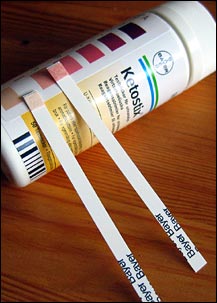
A few days ago, I was curious how I would fare when put to the ketonuria test, so I purchased a vial of Ketostix. The bottle and “stix” look exactly like the ones pictured here. I have tested a few times a day since purchasing and my results are usually the third or fourth darkest, with my highest result matching the second darkest. You can see the range of colors on the bottle in the picture for comparison. Suffice it to say, I am definitely in ketosis, as evidence by my measured ketonuria.
Weight
On a related aside, I weighed myself this morning and was happy to find myself hitting an exact 203.0 pounds wearing only my briefs. This means I have lost roughly two to three pounds in the last couple of weeks. I was expecting more, but I theorize that walking every day is building muscle while I am losing fat. If I had just been a big lazy butt and not exercised, I would have probably seen more of a drop. I expect to see between 1.5 and two pounds dropping per week beginning now.