Monday, May 2, 2011

Food Log: April 25–May 1

Here is a weekly report on food consumed for the period given in the posting title. I did drink a few cups of coffee every morning and may have forgotten to include them on a couple days. Since I drink them with nothing added, they have nearly zero calories so any difference would be insignificant.

Food Diary Report - Detailed - From FatSecret.com

Nutrient Breakdown:
71% of my calories came from fat.
24% of my calories came from protein.
5% of my calories came from carbohydrates.

Red Wine
I purchased an inexpensive bottle of red table wine a couple days ago on the theory that the supposed heart benefits (and feelings of well being) would outweigh any slight increase to my absurdly low carb intake. I am allowing myself four ounces per day, which is 3g of alcohol carbs (7 calories per gram). I don’t quite understand how 3g of carbohydrates, even as alcohol, can equal 100 calories, but that’s how the FatSecret site rates it. I am flying with that for now.

Keto Test
I sipped four ounces of wine while cooking lunch today and did a Ketostix test just after eating the finished meal. Interestingly enough, the four ounces of wine pushed me nearly out of ketosis. My results were second from lightest, which is two to three colors away from where I normally sit. I am sure I will return to normal in a few hours.

Sunday, May 1, 2011

Reading Between the Lines

This article was just published on the web by an M.D. Notice the very careful non-commital wording, phrasing and qualifiers employed. Note also the incredible claim in the title that eating fruit does not make you gain weight. Since you can gain weight if you eat enough of anything, including foods that are healthy for you, the title is clearly false. A more accurate title would have been “Fruits: The Naturally Sweet Treat That Doesn’t Cause Weight Gain When Eaten Sparingly” but that would be boring, right?

This is obviously a retort to the article published in the New York Times about the evils of sugar. I highly recommend that you watch the YouTube video linked at the beginning of the article.

The context for this whole debate is the increased intake of cheap corn sugars as a flavor replacement in low fat foods, all thanks to the low fat health craze promoted so heavily for the last 35 years. As proof, go to your local grocery store and examine 100 pre-packaged items at random. You will be hard-pressed to find more than 20 which do not contain some type of unnecessarily-added sugar, especially when focusing on pre-packaged “low fat” foods. The USDA has been kind enough to compile a list of the common names given to those “added” sugars.

(202.4 pounds this morning.)

Saturday, April 30, 2011

Keto-this, Keto-that

Ketogenic Diet
This is something I am on at the moment. A ketogenic diet is a “fat burning” diet. The Atkins Diet happens to be a ketogenic diet, but I am not following any direct Atkins guidelines.

Ketosis
One primary result of a ketogenic diet is an effect called ketosis, where the bloodstream has elevated levels of ketone bodies. Ketone bodies are formed from stored fatty acids after you have depleted your ready supply of glucose and your liver has also exhausted its glycogen stores.

Glycogen
Glycogen is the stored form of excess glucose. When you eat a meal rich in carbohydrates, your body converts the carbs into pure glucose and some other things. If you consume excess glucose, more than your body needs immediately, it is converted and stored away as future potential energy in the form of fatty acids and glycogen. This is why it is understood that a high-carb diet can actually make you fatter, even if you are restricting overall calories.

Fuel Priorities
As you go about your daily business, or sleep at night, your body must have energy to keep running, so it first turns to any free-floating glucose from any recent meal as its first fuel. Once that fuel has been depleted, it then turns to any glycogen stored in the liver. When that fuel has been depleted, your body’s last resort is to unpack the energy stored as fatty acids in your fat cells. However, it can only do this if your insulin levels are not elevated. Eating a meal rich in carbs is what elevates insulin levels. This is one of the main reasons to cut out a lot of carbs: they keep insulin elevated and inhibit the release of fatty acid fuel from the fat cells. You can have massive amounts of stored fatty acid fuel ready to be used, but find yourself completely unable to utilize it and feeling quite hungry as a result if you eat too many carbs and raise your insulin levels.

Ketone Bodies
Let’s assume you are not binging on carbs and your resulting insulin levels are low. When stored energy is released from fat cells in the form of fatty acids, it is converted to ketone bodies and ferried around the blood stream to hungry cells, just as glucose and glycogen would have been. Your body does quite well on ketone bodies. Your brain will go through an adaptation over a period of roughly six weeks where it is weaned off of the rich supply of glucose and glycogen and learns how to survive, quite well, on mostly ketone bodies. Speaking personally, the transition feels quite odd. It is known as the “ketosis flu” because you sometimes feel ill. It hits you pretty hard at first, then lessens as your body acclimates to the presence of so many ketone bodies.

Ketostix and Ketonuria
Linked via the web
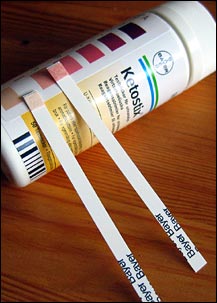
One of the side-effects of a ketogenic diet is that you have an abundance of these ketone bodies floating around the blood stream. You have so many, in fact, that you end up relieving the excess when you urinate, a medical condition called ketonuria. A product has been developed which allows you to measure this condition, basically confirming that you are indeed hitting that sweet spot of a ketogenic diet: being in a state of ketosis. You pee on the little reactive square at the end of the plastic stick. If it changes color and becomes darker, you are eliminating excess ketone bodies. The darker the result, the more you have ketonuria.

My Results
A few days ago, I was curious how I would fare when put to the ketonuria test, so I purchased a vial of Ketostix. The bottle and “stix” look exactly like the ones pictured here. I have tested a few times a day since purchasing and my results are usually the third or fourth darkest, with my highest result matching the second darkest. You can see the range of colors on the bottle in the picture for comparison. Suffice it to say, I am definitely in ketosis, as evidence by my measured ketonuria.

Weight
On a related aside, I weighed myself this morning and was happy to find myself hitting an exact 203.0 pounds wearing only my briefs. This means I have lost roughly two to three pounds in the last couple of weeks. I was expecting more, but I theorize that walking every day is building muscle while I am losing fat. If I had just been a big lazy butt and not exercised, I would have probably seen more of a drop. I expect to see between 1.5 and two pounds dropping per week beginning now.

Tuesday, April 26, 2011

Weekly Log: April 18–24

Warning: Ultra-boring post
The first week’s worth of data is ready to churn out. Calorie Counter attaches a nice weekly summary to the beginning of the PDF as shown in the screen capture below. According to my calculations, about 69% of my calories come from fat, about 10% from carbohydrates and about 21% from proteins. My weight has fluctuated between 204.4 pounds and 207.4 pounds.

Monday, April 25, 2011

Sharon Woods

Lisa and I live in Westerville, Ohio. I read somewhere that it has the highest number of public parks per capita of any town in the U.S.A. Our favorite is Sharon Woods. There is a four mile bike trail that runs in a loop and I took an 80 minute walk around it this afternoon in the pouring rain. After the rain subsided, I snapped some pictures, including one of a pair of deer. There’s also a shot of a bridge and a movie of the water gushing down what is normally a nearly bone-dry streambed as seen from the bridge.

©2011 Nathan Dickson

©2011 Nathan Dickson

©2011 Nathan Dickson

©2011 Nathan Dickson

SELF Nutrition Data

I stumbled upon a fairly comprehensive database of nutrition information at the SELF Nutrition Data website. You do not have to be a member in order to perform nutrition searches.

You can search by food name or by nutrient to obtain nutrition facts, various charts showing where this food fits into the nutrition spectrum and a detailed breakdown of all nutrients in several categories. I’ve never seen any other resource go into as much detail as this site.

For example, here is a link for an a voluminous collection of data on the nutrients in raw bananas. The screen capture below only shows about one third of the available page. You can already see that the data is well organized and quite detailed.

The only negative thing I have to say about the site is that it presents recommendations based upon the flawed notion that saturated fats and cholesterol are inherently unhealthy for you. This is the conventional wisdom that is now being challenged on many fronts.


Sunday, April 24, 2011

Counting Calories

/Facepalm
I am mentally scolding myself for falling into the calorie counting trap. Thanks to Lisa for pointing this out. The inclination to do so is hard to shake, given how much we’ve been brainwashed into thinking that changes to our weight will result from calories consumed minus calories burned. The Calorie Counter app (see links to the app on a previous blog posting) that I am using doesn’t help matters much.

Screen capture taken midday on Thursday, April 21st

Calorie Counter, by definition, helps you count calories. It does other useful things as well, for which I am grateful. However, the notion of calorie counting is fundamental to its purpose, hence the name. As you can see above, the Diet Calendar displays the number of calories I consumed in the Food column, the number of calories expended in the Exer. column and the net difference of the two in the Net column.

According to long-taught (and mistaken) nutritional theory, I should be losing about 631 calories worth of fat on Wednesday. Of course, no consideration has been given as to what constituted the calories I consumed, whether they were fat, protein or carbohydrates. It's all just generic calories.

Therein lies the problem with calorie counting. There are different metabolic pathways for the different types of calories. Fats are handled differently than proteins which are handled differently than carbohydrates. Also, no consideration is given to fiber, specifically high density carbohydrates coming in fibrous foods like fresh fruits. All of these factors change the way the body processes food (both pathway and timing) and, hence, render calorie counting as a somewhat misleading barometer of eating goodness.

So, if calorie counting is not the best thing to be doing, why use this app? I am now trying to use it for three functions:

1.  I want a comprehensive log of what I ate so that I can either confirm or disconfirm the newer very-low-carb dietary hypotheses when I get my physical in June. I am hoping to see the similar results to those realized by Gary Taubes. I have read that it may take a several months for things to settle in, so my results may still be a little off.

2.  I want to monitor the number of grams of carbohydrates I am consuming each day, so I know that I am maintaining them low enough to keep my body in a state of ketosis for as long as possible each day.

3.  I want to monitor my fat intake, so that I am aware of what percentage of my daily calories come from fat. From what I am now learning, it’s okay to go as high as 75%, which is very easy to do.